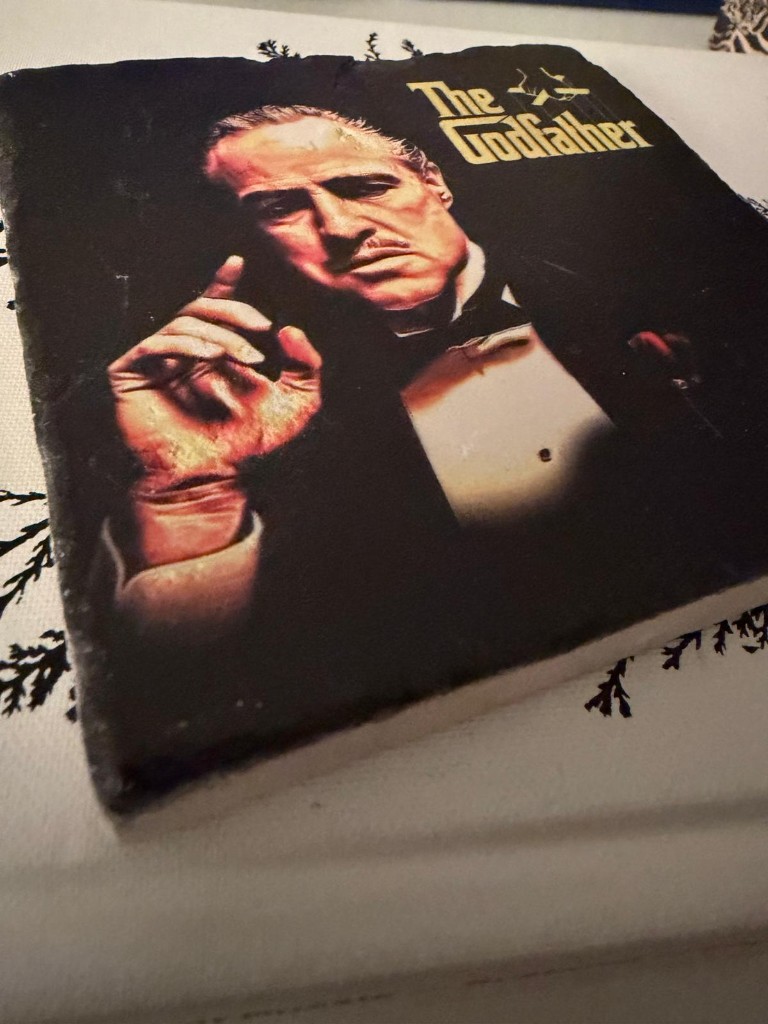
I watched three of the most violent films ever made in a week and walked away terrified of a guy sitting quietly in a chair by a lake.
The films were American Psycho, Pulp Fiction, and The Godfather. I’d seen all three before in pieces, catching thirty minutes on a flight or half-watching. But I’d never sat down and given each one my full attention back to back, and doing that made me notice a few things I want to tell you about. When I watch one violent film, I sorta notice the violence. When I watch three in a row, the violence starts to blur and what comes into focus instead is what each film is saying about the person doing it. Specifically, what it’s saying about what happens to someone who discovers they are exceptionally good at something and then has to decide what to do with that knowledge. That question, it turns out, is the one I haven’t been able to stop thinking about since, and not because I’m planning anything violent but because the pattern below it maps onto something much more ordinary and much closer to home than I was comfortable admitting.
Patrick Bateman
Patrick Bateman is the simplest case because he never has the question at all. He moves through the world with total competence and zero interiority. He can get a reservation at Dorsia, he can maintain a body that looks carved from marble, he can deliver a monologue about Huey Lewis and the News with the same detached precision he uses to swing an axe, and nothing registers internally as anything other than performance. The horror of American Psycho is that Bateman could stop murdering people tomorrow and nothing about his inner life would change, because there is no inner life. He is a machine that learned how to imitate a person so well that everyone around him accepts the imitation. The film’s most disturbing scene is the business card scene, where four men in a room have an emotional breakdown over the font on a piece of cardstock, because that’s the moment I realised that Bateman’s emptiness is not unique to him. The whole world of 1980s Wall Street he operates in seems to be empty.
Jules Winnfield
Jules Winnfield is the opposite, which is what makes his arc the most hopeful of the three and also the most unlikely. Jules spends the first half of Pulp Fiction as a man who is terrifyingly good at his job and completely uninterested in examining what that job is doing to him. He quotes Ezekiel 25:17 before killing people, and you get the sense that the Bible verse functions the same way Bateman’s business card does: it’s aesthetic and it’s performance. To me, it’s a way of dressing up something ugly so you don’t have to look at it directly. And then the bullets miss him in the apartment when someone fires at point-blank range and every round goes into the wall behind him. Jules calls it a miracle and Vincent (his buddy) calls it a freak occurrence. The entire rest of their relationship plays out as a disagreement about whether that moment meant something, and Tarantino’s answer is that it simply doesn’t matter whether it was divine or random because what matters is that Jules let it change him. He sits in that diner at the end, gun on the table, and he chooses to walk away. He has one flash of self-awareness and he treats it as enough to rebuild his entire life around. I think that a lot of people get that flash and they go back to work on Monday. I find that unreasonably moving for a scene that also involves someone robbing a restaurant in a Hawaiian shirt.
Michael Corleone
And then there’s Michael Corleone, and this is where it gets personal for me. Michael starts The Godfather as the one who got out — the war hero, the Ivy League kid, the one the family is proud of because he is not involved in the family business. He sits at his sister’s wedding and tells Kay about his father’s world with the detachment of someone describing a culture he studied rather than one he was born into. And then his father gets shot, and Michael discovers something about himself: he can handle it. He can sit across from Sollozzo in that restaurant with a gun taped behind the toilet and keep his composure. The problem for his character was not him being forced into the family business by circumstance. The problem is that he’s good at it. If he’d been bad at it, if the restaurant had gone wrong, the story would have ended there. But he was excellent.
Excellence is its own kind of trap because once people see what you’re capable of, they need you to keep doing it, and once you see what you’re capable of, you start to believe that capability is the same thing as purpose.
That’s the pattern I recognised, and I want to be careful here because I am not comparing my life to the Corleone family’s in any literal sense. I write SQL queries for a solar energy startup. The most dangerous thing I do on a given Tuesday is drink a fourth coffee after 3pm. But the underlying mechanic, being the person who can handle it so you become the person who must handle it, that I know well. I co-founded two companies before I graduated — I took on more than any reasonable person would advise during university (alongside building a marriage) because I could, and because I could, people let me, and because people let me, it became my identity. The capable dude and the guy who figures things out. And that identity is seductive because from the outside it looks like ambition and competence and drive, and from the inside it slowly becomes a cage where I can never admit that I’m overwhelmed because admitting that would mean I am not the person everyone, including myself, has agreed that I am.
Michael Corleone’s tragedy is that he kept choosing the wrong life, one decision at a time, each one perfectly rational in isolation, each one making the next one slightly more inevitable, until he wakes up in that chair by the lake as an old man who has won every fight and lost every person who ever mattered to him. He had self-awareness. That’s what makes it a tragedy rather than a horror story. He knew, at multiple points, that he was becoming something he originally defined himself against. He overrode that knowledge every time because the situation demanded it, because he was the only one who could handle it, because stepping back would have meant letting the thing he and his father had built collapse. The last shot of The Godfather Part II, Michael sitting alone, remembering a version of himself that no longer exists, is the most frightening thing I’ve ever seen in a film. Because of how understandable every step of it was.
I’m 22. I’ve been married for a year to someone I love across three cultures and two languages. I work at a startup where I’m learning more than I thought was ever possible. I write this blog because writing is how I figure out what I think, and what I think right now is that competence is the most dangerous trait a person can have if they never develop the habit of asking themselves whether the life they’re building is one they’d recognise in ten years. Bateman never asks the question and disappears into his own emptiness. Jules asks it once and lets the answer save him. Michael asks it, hears the answer, and decides he can’t afford to listen. I’d like to think I’m closer to Jules than to Michael, but the honest truth is that most ambitious people like me are closer to Michael than they’d ever admit, because Michael’s mistake is reasonable. And it’s practical. It’s what anyone would do in his position, one small override at a time, until the overrides become the person. I don’t have a clean ending for this because I don’t think the question has one. I think you just keep asking it and hope that the asking itself is enough to keep you from ending up in that chair by the lake. Probably the most unsettling thing about watching these three films back to back is that I came away less sure about that than I was before I pressed play.